Energy & Carbon
Find it: Energy in the sidebar — Dashboard, Target Tracking, Carbon Footprint, Sustainability Reports, Emission Factors.
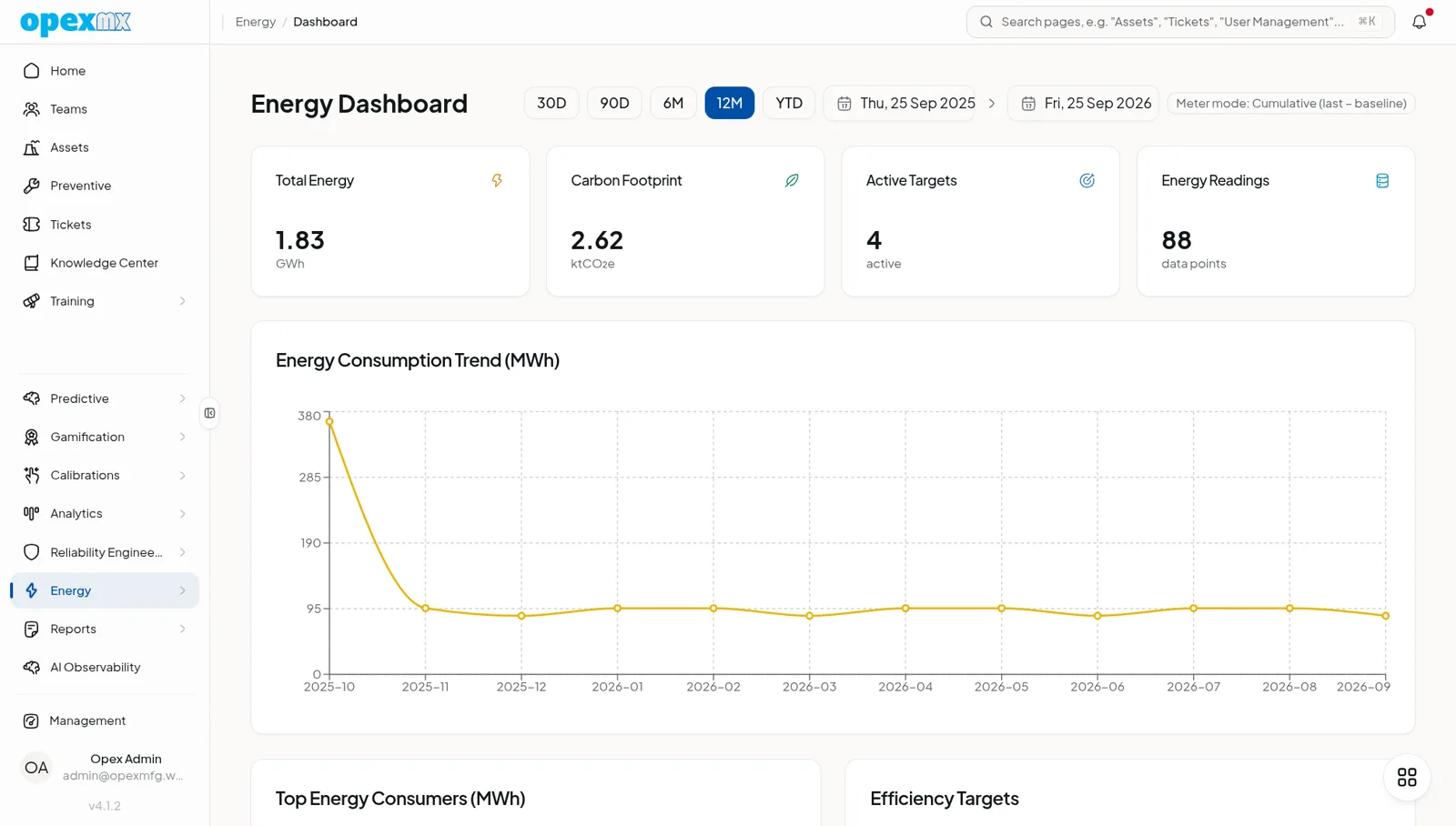
Sound familiar?
- "The board wants our carbon number — where do I even start?"
- "Our energy data is in the meter vendor's portal, not ours."
- "Sustainability reporting is a month-long spreadsheet exercise."
Energy and emissions are now operational data, not an annual project.
The Problem
Energy readings sit in disparate meters and bills. Carbon is a year-end estimate. Targets, if they exist, aren't tracked against actuals. When reporting season hits, someone rebuilds it all in a spreadsheet.
What OpexMX Energy & Carbon Does
Pulls energy consumption from the same machine-parameter pipeline you already use for maintenance, computes CO2e against emission factors, and turns it into targets and reports.
Consumption, Two Meter Modes
Readings come in per asset/parameter. The system handles both meter styles: delta (sum of period readings) or cumulative (last reading minus a baseline) — auto-detected, so you don't model it wrong.
Targets with Achievement
Set targets per asset/parameter/site with a baseline, unit, and period (daily/weekly/monthly/quarterly/annual). Current value and achievement % are computed live; status moves active → completed → archived.
Carbon Footprint, Live
CO2e is computed by joining energy readings to emission factors (scope 1/2/3, per fuel type and region), picking the valid factor for the period, and grouping by scope, asset, site, or fuel type.
Emission Factors
Maintain your own factor library — fuel type, scope, CO2e factor, unit, region, validity window — sourced and versioned.
Sustainability Reports
A report auto-computes totalEnergyKwh and totalCo2eTonnes from raw readings on create, with water, waste, and report data, then flows through an approval workflow (draft → pending_approval → approved → published).
How It Works
- Energy parameters feed readings (meters, PLCs, manual entry).
- Consumption aggregates per period (delta or cumulative).
- Emission factors convert energy to CO2e.
- Targets track actuals against goals.
- Sustainability reports roll it up for stakeholders.
Who Uses This?
| Role | What They Care About |
|---|---|
| Sustainability / ESG | Defensible carbon and energy numbers |
| Operations | Energy waste by asset or site |
| Finance | Target tracking and reporting cadence |
| Management | Board-ready sustainability report |
Pro Tips
- Tag energy parameters consistently so grouping by site/asset works.
- Keep emission factors versioned — regulators ask for provenance.
- Set realistic quarterly targets before annual ones.
- Let the report auto-compute; only override with a documented reason.
Integrations
- Assets / Parameters: energy readings come from the same parameter pipeline
- Dashboards: energy-consumption and carbon-footprint data sources
- Reports: sustainability reports for ESG disclosure